
FAQ – Route calculation with working hours mode
This feature provides more accurate route durations by including mandatory rest and break times in the calculation.
Table of contents
Q. How does the system determine where to place breaks and rest periods on a route?
A. This feature adds a Working hours mode to route calculation when the routing provider is PTV. The total duration of a load is no longer based only on theoretical driving time; it also includes the necessary driver rest periods.
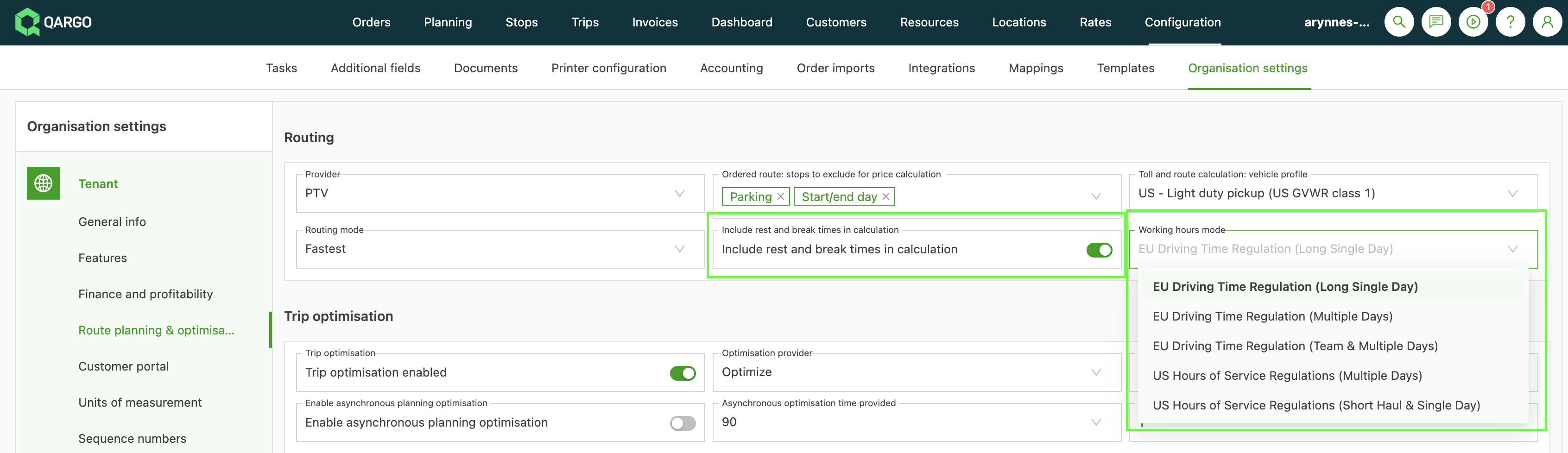
At the core of the feature is the option to select a Working hours mode preset. This preset governs how rest times are calculated when the routing provider is set to PTV:
-
Preset configuration: Select a preset in Organization settings. This preset defines a specific set of parameters that determine driving and resting times, including:
- Maximum driving time between breaks
- Total daily driving time
- Total travel time
Optionally, add:
-
Break duration
-
Daily rest time
-
-
Calculation: Once a preset is selected, the route calculation takes these parameters into account. The system dynamically inserts the necessary breaks and rest periods based on the limits defined in the chosen preset.
-
Viewing the route: The general info of a load shows the route, with rest times included in the total duration.

-
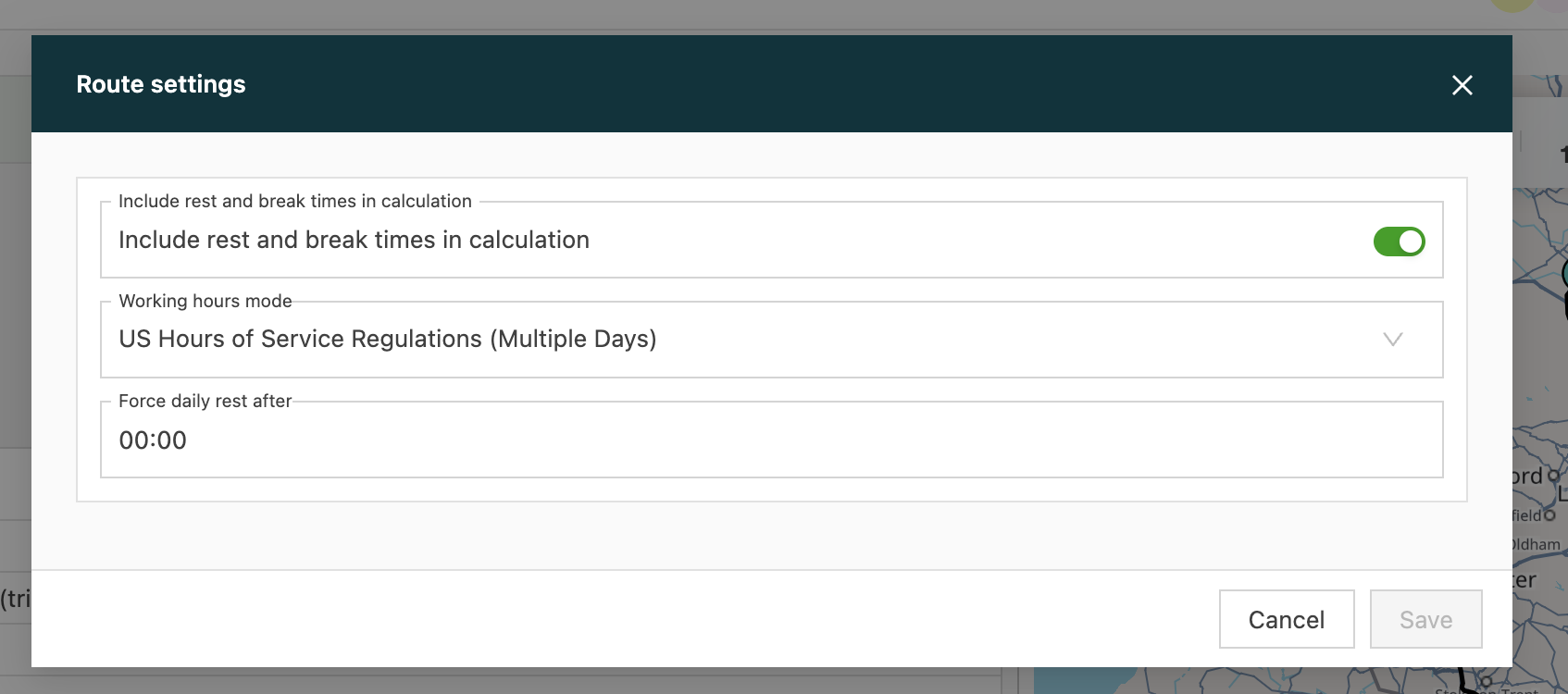
Load overrides: The working hours calculation for an individual load can be modified through the Route settings option. Here, it is possible to:
- Change the working hours mode (select a different preset).
- Toggle whether to include rest times in calculation.
- Choose to force daily rest after a certain time.
This process makes the calculated duration more accurate. It reflects the time the driver needs to complete the route while following the specified working hours profile.
| Preset name | Basis and description | Key parameters (example) |
|---|---|---|
| EU DRIVING TIME REGULATION FOR LONG SINGLE DAY | Based on Directive 2003/88/EC and 2002/15/EC: if total working hours exceed 9 hours, a break must be at least 45 minutes long. | Break time: 45 minutes\ |
| Maximum driving time between breaks: 4.5 hours\ | ||
| Maximum driving time: 10 hours\ | ||
| Maximum travel time: 15 hours | ||
| EU DRIVING TIME REGULATION FOR MULTIPLE DAYS | EU regulation for loads spanning multiple days; daily rest can be scheduled anywhere. | Break time: 45 minutes\ |
| Maximum driving time between breaks: 4.5 hours\ | ||
| Daily rest time: 11 hours\ | ||
| Maximum driving time between daily rests: 9 hours\ | ||
| Maximum travel time between daily rests: 13 hours\ | ||
| Daily rest position: anywhere | ||
| EU DRIVING TIME REGULATION FOR TEAM AND MULTIPLE DAYS | When two drivers form a team, they can take turns. In contrast to EU DRIVING TIME REGULATION FOR MULTIPLE DAYS, no breaks are scheduled and the daily rest time limits are raised. | Daily rest time: 9 hours\ |
| Maximum driving time between daily rests: 18 hours\ | ||
| Maximum travel time between daily rests: 21 hours\ | ||
| Daily rest position: anywhere | ||
| US HOURS OF SERVICE REGULATIONS FOR MULTIPLE DAYS | HOS rules for multi-day loads; daily rest can be scheduled anywhere. | Break time: 30 minutes\ |
| Maximum driving time between breaks: 8 hours\ | ||
| Daily rest time: 10 hours\ | ||
| Maximum driving time between daily rests: 11 hours\ | ||
| Maximum travel time between daily rests: 14 hours\ | ||
| Daily rest position: anywhere | ||
| US HOURS OF SERVICE REGULATIONS FOR SHORT HAUL AND MULTIPLE SINGLE DAYS | HOS short-haul rules for multi-day loads with rest between loads. | Maximum driving time between daily rests: 11 hours\ |
| Maximum travel time between daily rests: 14 hours\ | ||
| Daily rest position: between loads |