
PN – Pallet networks: what, why and how
A pallet network unites regional carriers through shared hubs and ZIP code zones to deliver palletized freight nationwide efficiently. It reduces empty miles and boosts coverage through tech-driven collaboration.
Table of contents
1. What is a pallet network?
A pallet network is a collaborative logistics model. Multiple regional trucking companies (called members) work together to provide nationwide palletized freight coverage.
Each company does not run long-distance vehicles across the country. Instead, members share infrastructure, primarily a central hub and structured ZIP code zones, to pick up, consolidate, and distribute pallet freight efficiently.
In simple terms, a pallet network lets a local carrier pick up freight from their customers and send it through the network overnight. Another local member in the destination area then delivers it the next day, anywhere in the country.
This model makes regional carriers part of a national delivery system. Their local expertise and customer relationships stay intact.
2. Why pallet networks exist
Before pallet networks, regional carriers often faced inefficiencies with smaller palletized shipments bound for distant areas. These loads were too small for full truck runs but too large or costly for parcel carriers.
Pallet networks solve this by:
- Pooling resources – Each member focuses on local pickups and deliveries and shares linehaul routes and a central hub.
- Reducing empty miles – Outbound and inbound loads are balanced across members.
- Improving service reach – At least one member covers every ZIP code in the UK and Ireland.
- Enabling small-load efficiency – One pallet or a few pallets can move nationwide at a controlled cost and service level.
This collaboration delivers economies of scale, reliable service standards, and traceable pallet movements. All of these benefit both carriers and customers.
3. How pallet networks operate
Operations typically follow a hub-and-spoke model:
- Local pickup
Each member picks up palletized freight from their customers within assigned ZIP codes. These pallets are scanned, labeled, and loaded onto linehaul vehicles. - Linehaul to the hub
At night, the members’ linehaul vehicles travel to the network hub, a central transshipment site. Pallets from all regions are unloaded, sorted by destination terminal, and reloaded onto outbound linehaul vehicles. - Outbound linehaul
After sorting, vehicles return to their home terminals with freight bound for their delivery area. - Local delivery
The receiving terminal performs final-mile deliveries to receivers and completes the network cycle.
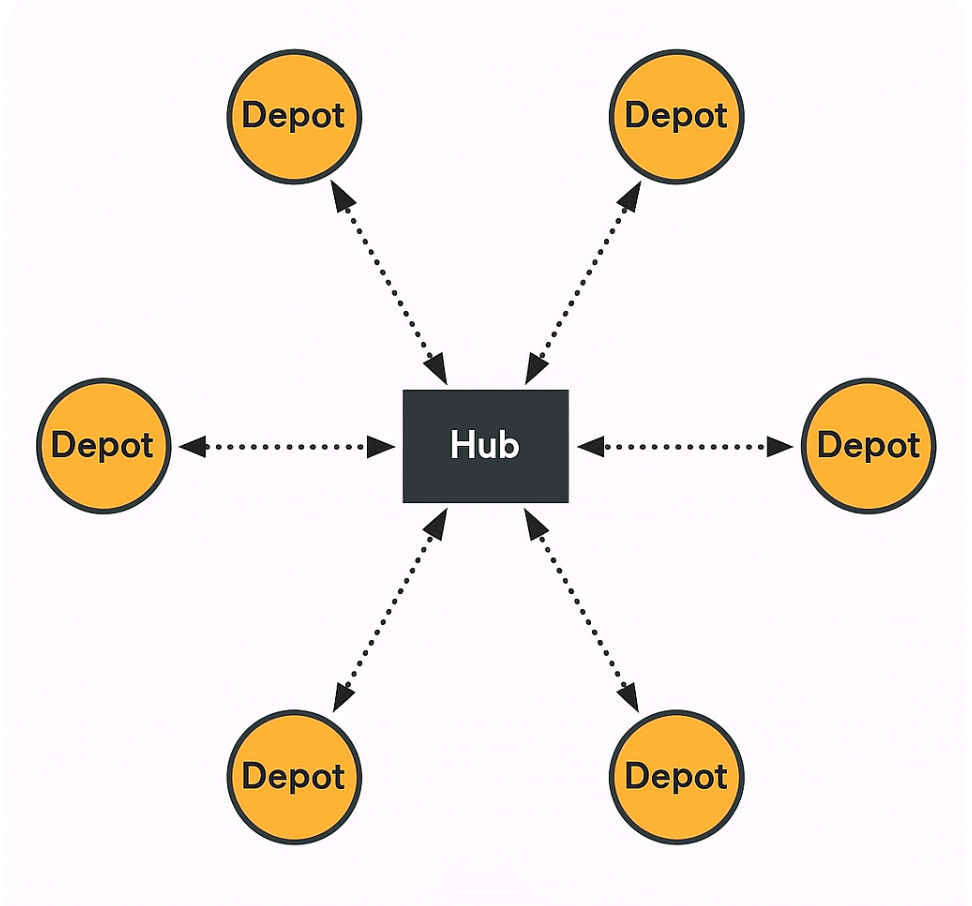
Throughout this process, barcode scans track pallet movements, and the network’s IT systems monitor performance.
3. The role of technology
Modern pallet networks rely heavily on digital platforms to coordinate activity across dozens or even hundreds of members.
Transportation management systems (TMS) integrate directly with network IT to:
- Exchange shipment data automatically,
- Print compliant labels,
- Receive scan updates and ePODs, and
- Manage billing through self-billing interfaces.
This integration ensures consistency, visibility, and compliance across all terminals, hubs, and service levels.
4. Pallet network integrations with Qargo
Qargo actively supports integrations with the following pallet networks. Exact data flows and feature coverage differ by network and integration status.
| Network | Order import | Order export | Labels | Status sync | ePOD | Delivery images | ETA | Customer paperwork |
|---|---|---|---|---|---|---|---|---|
| Palletline | ✔ | ✔ | ✔ | ✔ | ✔ | * | * | * |
| Palletforce | ✔ | ✔ | ✔ | ✔ | ✔ | * | * | * |
| TPN | ✔ | * | ✔ | ✔ | ✔ | * | * | * |
| UPN | ✔ | * | * | * | ✔ | ✔ | * | * |
| The Hazchem Network | ✔ | ✔ | ✔ | ✔ | ✔ | ✔ | * | ✔ |
| PallEx / Fortec | ✔ | ✔ | ✔ | ✔ | ✔ | * | * | * |
| Palletways | * | * | ✔ | ✔ | ✔ | ✔ | * | * |
| Pallet Express | * | * | * | * | * | * | * | * |
| Pallet Track | * | * | * | * | * | * | * | * |
Notes:
- ✔ = Available in the integration
- * = Available with restrictions – refer to the network documentation for details
- X = Not supported
*TPN ETA sync is supported in one direction only (TPN → Qargo). ETAs update automatically in Qargo when they are available in the TPN portal. Sending ETAs from Qargo to TPN is not supported.